

196.9K
Downloads
180
Episodes
Review and discussion of recent literature in point of care ultrasound.
Episodes
Monday Nov 11, 2019
Monday Nov 11, 2019
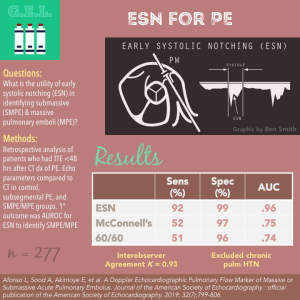
A focused echo can go a long way in a patient with a suspected pulmonary embolus (PE). It can be especially valuable in those that are so sick and unstable that you need answers right away. In this way, point-of-care echo has been shown to help to diagnose submassive and massive pulmonary emboli by identifying signs of right heart strain. Echo parameters such as right ventricle diameter and right ventricular function (such as in TAPSE) are often part of the evaluation, but these are not as accurate as we would like. These authors propose a new doppler marker of a submassive or massive PE- enter the Early Systolic Notching pattern. https://www.ncbi.nlm.nih.gov/pubmed/31056367
Monday Oct 28, 2019
Monday Oct 28, 2019
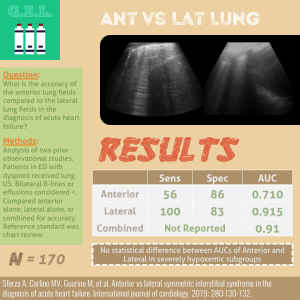
Suspected acute heart failure is a great reason to use point-of-care ultrasound. It can tell you in seconds if this patient is up to their neck in pulmonary edema. Knowing that interstitial edema is more common in dependent areas of the lung, one would think that the lateral areas of the lung fields would be most sensitive for the diagnosis. Likewise, if there is enough pulmonary edema to fill up the anterior lung fields, this theoretically should be pretty specific. But is this actually true?! These authors investigate the issue. https://www.ncbi.nlm.nih.gov/pubmed/30665807
Tuesday Oct 15, 2019
Tuesday Oct 15, 2019
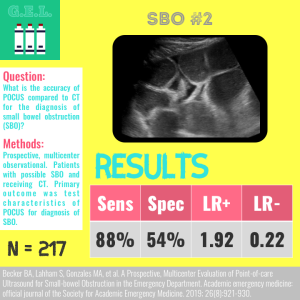
POCUS can be used to visualize small bowel obstruction (SBO) fairly easily. It has proven itself superior to xrays and has some advantages over CT, which for most people is the standard for diagnosis. Although initial work was quite promising, there were no large studies done confirming the accuracy of ultrasound for this purpose. In this podcast we examine the latest study (plus discuss a bonus similar one) that reveals maybe this is not as good as we thought! https://www.ncbi.nlm.nih.gov/pubmed/30762916
Monday Sep 30, 2019
Monday Sep 30, 2019
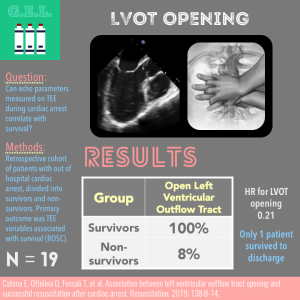
There are many ways that TEE can help you in cardiac arrest. One of these is to monitor your chest compressions to make sure they are actually doing what you want. Although this makes sense intuitively and is supported by animal models, there has not been a lot of evidence to date. This article takes a step in that direction by showing some data on outcomes in humans. https://www.ncbi.nlm.nih.gov/pubmed/30825552
Monday Sep 02, 2019
Monday Sep 02, 2019
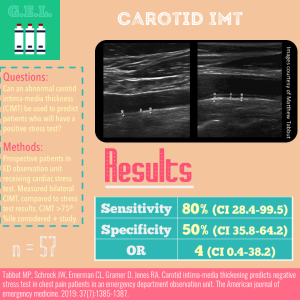
We know that the carotid arteries are easily seen on ultrasound, but usually we think of this scan in the context of comprehensive sonography. Certainly, it is not hard to believe that having increased atherosclerotic build up would put someone at increased risk for coronary artery disease, but what can we do with that in the acute setting? These authors had an idea - maybe measuring the Carotid Intima-Media Thickness (CIMT), could be a predictor of the outcomes of a cardiac stress test. Is this brilliance or craziness? Decide for yourself! https://www.ncbi.nlm.nih.gov/pubmed/30612781/
Monday Aug 19, 2019
Monday Aug 19, 2019
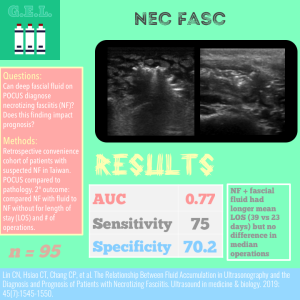
Necrotizing fasciitis (NF) is a real bad deal. We usually rely on clinical exam (which can be misleading) or other imaging studies (which can take forever) to make the diagnosis. POCUS would be an awesome solution in helping to make this time-sensitive determination. We know it can pick up fascial fluid, air, subcutaneous changes...but really how good is it when it comes down to diagnosing this deadly disease? https://www.ncbi.nlm.nih.gov/pubmed/31031033
Monday Aug 05, 2019
Monday Aug 05, 2019
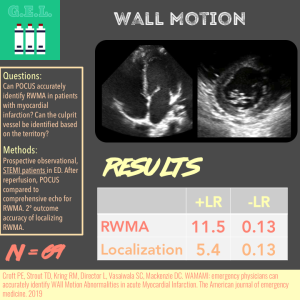
Theoretically, regional wall motion abnormalities (RWMA) would be really useful in the acute care setting. In the patient with concern for cardiac ischemia, this finding might help push to definitive management. The problem is that this is a nuanced exam - it takes some experience and practice. It hasn't been studied much in the point-of-care world. So can emergency physicians with relatively little training do this accurately? Find out in this next adventure into the world of point-of-care echocardiography! https://www.ncbi.nlm.nih.gov/pubmed/30987914
Monday Jul 22, 2019
Monday Jul 22, 2019
In part 2 (and the finale) of the series from the IAEM conference, the discussion heats up even more! The same star-studded international band of wisdom and wizardry tackles POCUS in cardiac arrest. They discuss the CASA exam and other pointers for using POCUS in the pulseless patient. A must listen!
Monday Jul 08, 2019
Monday Jul 08, 2019
In October 2018, an all-star group met during the Irish Association for Emergency Medicine annual conference to talk about point-of-care ultrasound. The result was a convivial discussion of a few key papers and topics, packed with pearls and perspectives. In part 1 of 2, the group talks about the landmark original SHoC-ED trial and performing the erector spinae plane block for rib fractures.
Monday Jun 24, 2019
Monday Jun 24, 2019
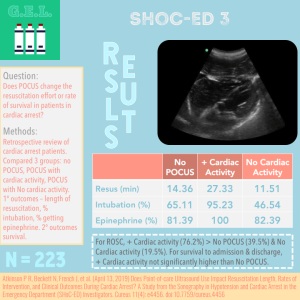
It is great to see more and more research on ultrasound in cardiac arrest. Although many people are already using this, there is still much work to be done to tease out the details of how exactly POCUS should affect our decision making. Here is a nice study that looks to see if ultrasound is associated with increased resuscitation efforts or better survival outcomes. https://www.ncbi.nlm.nih.gov/pubmed/31205842