

196.9K
Downloads
180
Episodes
Review and discussion of recent literature in point of care ultrasound.
Episodes

Monday Mar 05, 2018
Monday Mar 05, 2018
What do you get when a bunch of POCUS and social media lovers get together to teach ultrasound? A podcast! This is part 1 of a round-table discussion of several articles in critical care ultrasound. The star-studded international collection of voices reviews the data and examines how it informs their practice.
Monday Feb 26, 2018
Monday Feb 26, 2018
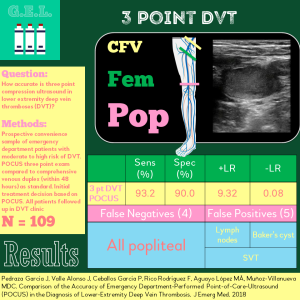
Point of care ultrasound can be great for finding and excluding deep vein thrombosis, but this is a high-risk diagnosis, so we want to be sure. Previous evidence has shown that a cursory look at two points along the lower extremity was not sufficient to rule out a DVT. This article attempts to re-examine the accuracy of POCUS for this indication with a more thorough examination.
Monday Feb 12, 2018
Monday Feb 12, 2018
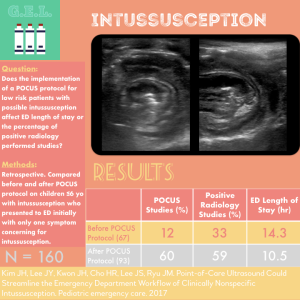
Intussusception is hard to spell - but is it hard to see on point-of-care ultrasound? Fortunately, no it's not. This study aims to see what happens when an emergency department starts implementing a "POCUS-first" strategy in children who may have intussusception.
Monday Jan 29, 2018
Monday Jan 29, 2018
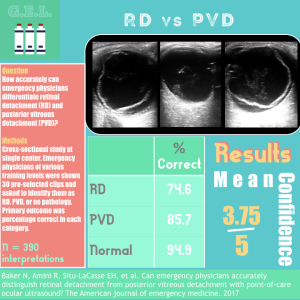
Retinal detachment and posterior vitreous detachment can present very similarly. Retinal detachment is generally a more serious condition. Ultrasound can find both pathologies, but how well can POCUS users distinguish between these two? Answer :(
Monday Jan 15, 2018
Monday Jan 15, 2018
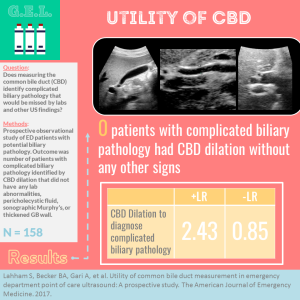
Measuring the size of the common bile duct is a standard part of the sonographic evaluation for biliary pathology. Sometimes this can pose a challenge as it is often very small when not pathologically dilated. These authors wanted to find out how important this measurement is when diagnosing complicated biliary diseases. Read on to find out - do we need to keep measuring this or can we forget about it?
Monday Jan 01, 2018
Monday Jan 01, 2018
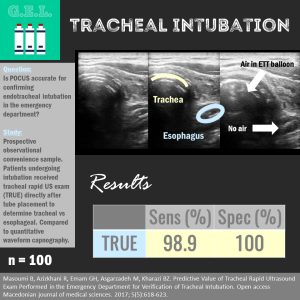
There are many ways to skin a cat and there are many ways to confirm that your endotracheal tube in actually in the trachea. But aren't you tired of using those boring old techniques? The idea here is that you can use point-of-care ultrasound to visualized the air-filled ETT ballon and potentially save time in confirming your endotracheal tube placement after intubation. This study aimed to determine the accuracy of this technique.
Monday Dec 18, 2017
Monday Dec 18, 2017
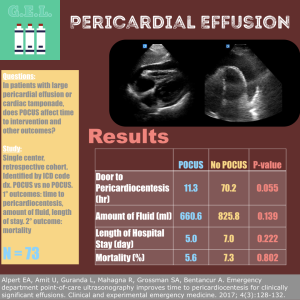
Pericardial effusions can be difficult to diagnose clinically. Luckily, ultrasound is the diagnostic of choice for finding those sneaky effusions. While we may know (in our hearts) that point of care ultrasound can be helpful in making this diagnosis, there is not a lot of literature showing improvement in patient centered outcomes. This study aims to see if performing a POCUS exam in the emergency department changed any meaningful outcomes for the patients that required a procedure to drain the fluid.
Monday Dec 04, 2017
Monday Dec 04, 2017
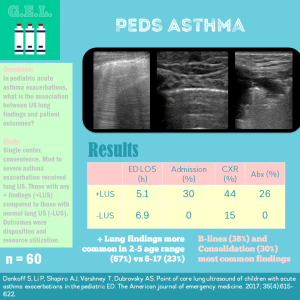
I know what you're thinking...lung ultrasound in asthma?! - they should have a totally normal lung ultrasound, right? Traditionally, harkening back to the BLUE protocol - diseases such as asthma and COPD were diagnosed on ultrasound once every other cause of respiratory symptoms had been excluded and the patient had no other lung findings or DVT. With this background, this study wanted to evaluate pediatric patients in asthma exacerbation to see what lung ultrasound findings might be present, and when they were - what that meant for the patient.
Monday Nov 20, 2017
Monday Nov 20, 2017
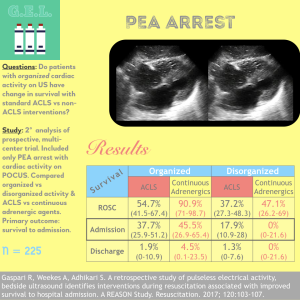
This is the second study from the REASON group - one of the most rigorously performed studies of ultrasound in cardiac arrest. In this article, they are looking at the population in pulseless electrical activity (PEA) with cardiac motion on ultrasound. From this group, they differentiate those with organized rhythms. The idea is that perhaps this population would have a different survival or respond to treatments differently. By reanalyzing their previous data, they are able to answer these questions.
Monday Nov 06, 2017
Monday Nov 06, 2017
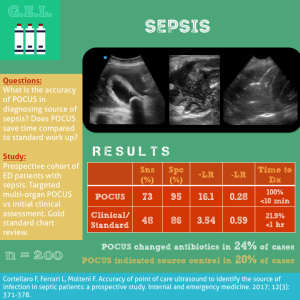
We know that POCUS can be used to diagnose many different types of infection. We also know that these infections can lead to serious systemic illness in the form of sepsis. Whenever we see a patient with sepsis, we want to know the source infection as quickly as possible so that we can treat it appropriately with antibiotics and/or a procedural intervention. Therefore, this paper takes a look to see if using ultrasound in the diagnostic work up of these undifferentiated infected patients can help diagnose the source and lead to better treatment.